
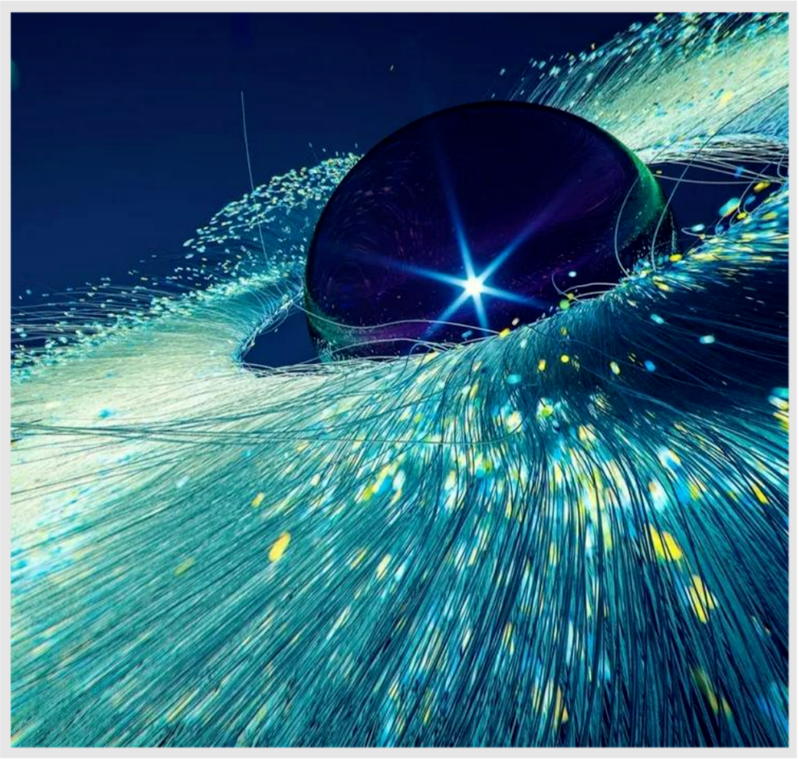
Physicists in Japan, the United States, and China have broken through in the field of quantum magnetism using atoms that are about 3 billion times colder than interstellar space [1]. The quantum simulator developed at Kyoto University uses up to 300,000 atoms, enabling physicists to directly observe how particles interact in a quantum magnet with a complexity beyond the capabilities of even the most powerful supercomputers, realizing the quantum superiority of quantum magnet simulations.
In the quantum simulator, lasers are used to cool fermions (ytterbium atoms) to about one part per billion of absolute zero - a temperature that even all motion stops cannot reach.
The research results were published on September 1 in the journal Nature Physics under the title "Observation of antiferromagnetic correlations in the ultracold SU(N) Hubbard model" [2].
Co-authors of the study include Shintaro Taie, Naoki Nishizawa and Yosuke Takasu of Kyoto, Hao-Tian Wei of Rice University and Fudan University in Shanghai, Yoshihito Kuno of Tsukuba University in Ibaraki, Japan, and Richard Scalettar of the University of California, Davis.
01Simulating the quantum Hubbard model: first revelation of magnetic correlations in SU(6)
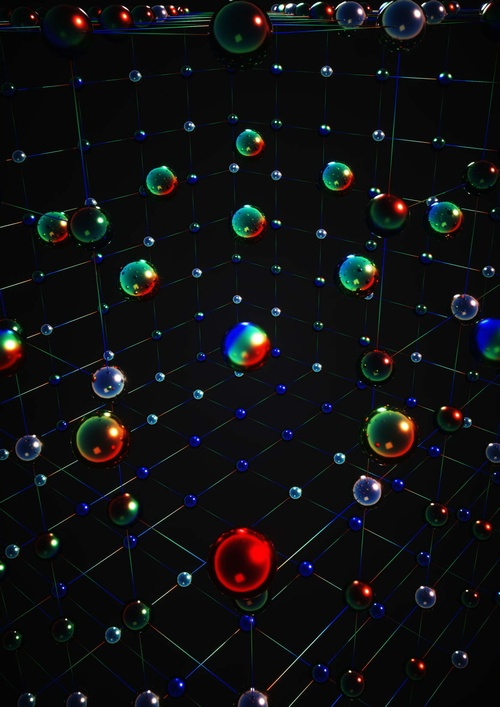
The team showed that it can capture up to 300,000 atoms in its 3D lattice [3].
02Beyond classical computers, particle cooling goes further
03In the future, it is expected to create high-temperature superconductors
[2]https://www.nature.com/articles/s41567-022-01725-6